A classic tale, told plainly
The tale so far
A princess is held in the castle at the head of a long valley. A knight sets out at sunrise to free her. That is the whole of the quest, and the scroll he carries says it in one line: Free the Princess from the castle at the head of the valley.
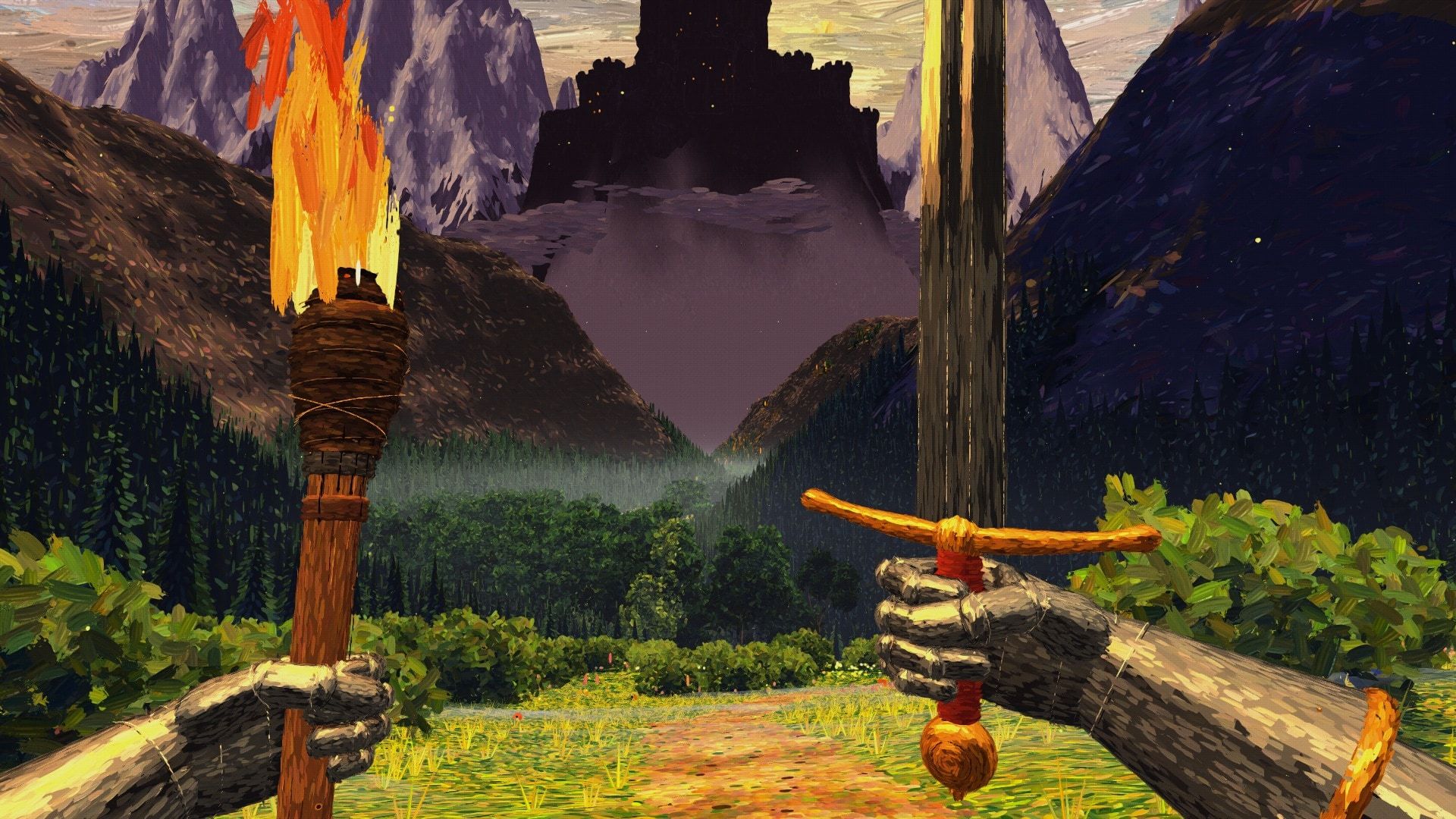
The tale opens at his camp in a hollow just short of the road, in the blue hour before sunrise. He sits by his fire while you choose to begin; then he lights his torch at the flames, kicks earth over them, takes up his sword and walks up onto the road, and the eye goes with him into his helm. From there on you are the knight.
A Painted Tale is a story of the old kind: one hero, one road, one place to reach. What it adds is the road itself. The valley is six kilometres long, the castle is in sight from the first step, and everything between the two is there to be walked through, looked at, talked to or fought.
Three seasons, one day
The valley is walked through three seasons, and through one day. The day does not run by a clock: it turns with the distance the knight has come. Each region’s name comes up on the screen as he enters it.
| Region | Along the valley | Hour | What is there |
|---|---|---|---|
| Summer’s Vale | 0 to 2000 m | Sunrise to afternoon | Low fog at dawn, flower meadows, butterflies, a hamlet of farmers with its inn, the Moss Golem |
| Autumn’s Dale | 2000 to 4000 m | Golden hour to sunset | Woods in gold and russet, falling leaves, the sun going down behind the walker |
| Winter’s Hollow | 4000 to 6000 m | Dusk to night | Snow that never goes, blizzards, torchlight, Rimefang and his pack |
| Mountain Mine Entrance | 6000 m | Night | A gorge, a rope bridge, and a door in the cliff under the castle |
The Stag’s Head
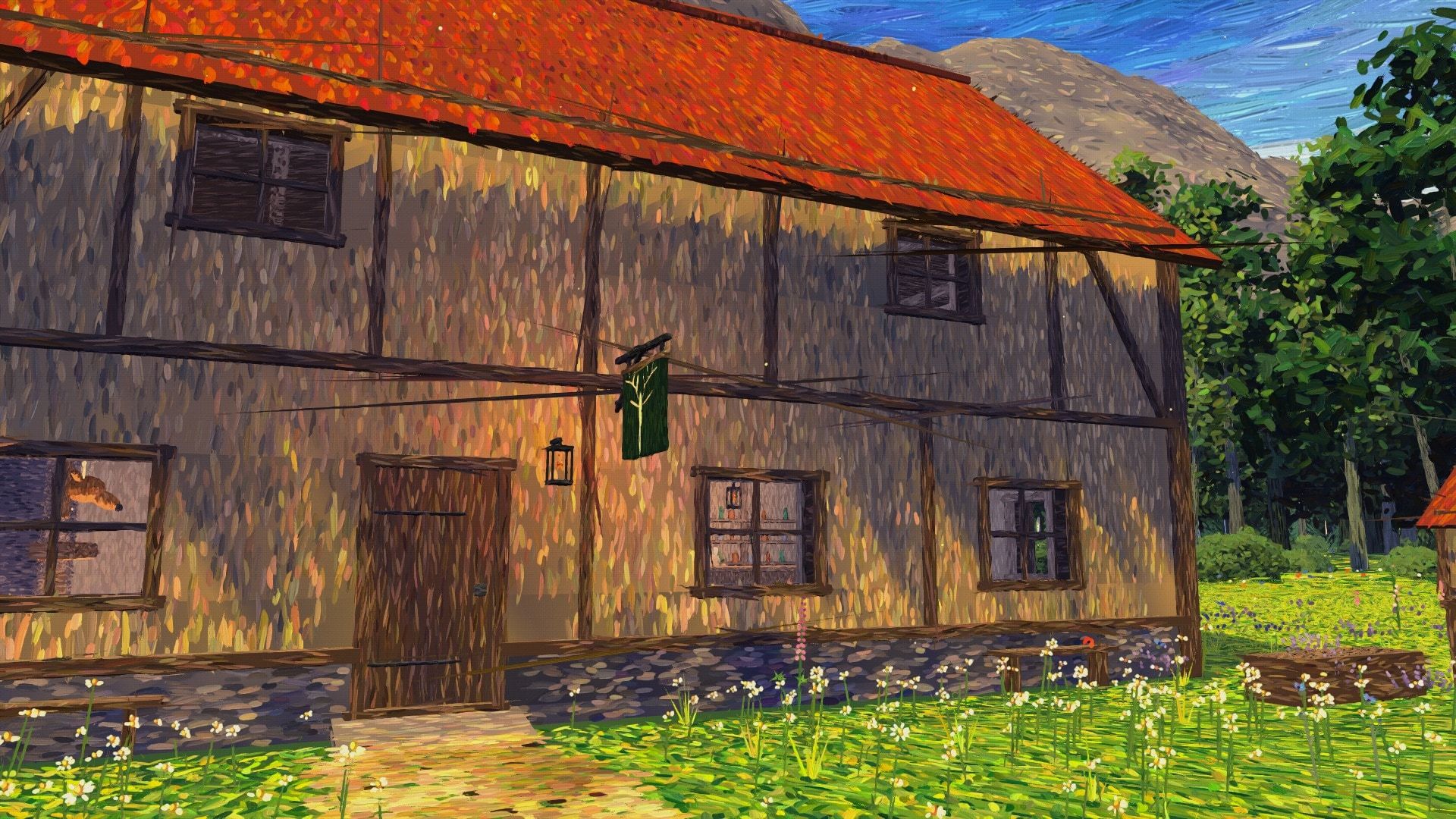
A tenth of the way up the valley, about 560 metres in, stands a hamlet round a green, and on the green an inn called The Stag’s Head. The knight can walk in. The innkeeper greets him:
“Well now, a knight! Mind your head on the beam. Everyone does, the once.”
He will talk for as long as the knight will listen, and the knight chooses his own replies. From him come the valley’s news and its second quest, The Wolf of the Hollow: the wolves are down from the snow again, a great white one leads them, and the shepherds have a name for him.
“Rimefang, the shepherds call him. Bold as a bishop and twice as hungry.”
The knight may take the task, ask where to find the wolf, or say it is not his concern. The offer stands.
The hamlet is at its morning’s work around the inn. A farmer hoes his vegetable bed, a farmwife flings grain to her hens from a basket, and an old man pitches hay onto a stack and leans on his fork between. There are gardens behind the cottages, a field with a scarecrow, pigs in a sty, sheep in a fold, a coop, barrows and tools left where they were last used. The hens run from a knight who comes too close; the pigs and the sheep trot off a few steps and turn to look.
Halfway through, a boy with a wooden sword sees the knight and runs up to him:
“Wow, a real knight! One day I’m going to be a knight too!”
Who is on the road
- The Moss Golem. Three and a half metres of stone and moss, wandering a meadow of Summer’s Vale past the village. It slams, sweeps and stomps.
- The spiders. A mother and her brood. They pounce, and they throw web that slows whoever it catches.
- Rimefang and his pack. The white wolf of Winter’s Hollow and four greys, hunting by night in the snow.
Against them the knight has a sword in one hand and a torch in the other, and a dodge. His health is the red liquid in a gem set in the sword’s cross: there is no bar on the screen.
The story told again
A Painted Tale is told by someone, and the teller knows how it ought to go. If the knight falls, the telling stops: “...But that’s not how the knight’s tale ends!” The tale is taken up again from a little way back down the road. If the knight does a thing no knight of this tale would do, that is taken back too: “...No, no. That is not what happened.”
What is not told here
The innkeeper says that some evenings there is a glint up on the keep, “a little star where no star ought to be”, and that the old miners’ road ends at a door in the rock which opened once, long ago, “for a man with the right light about him”. What those mean is for the road to tell.
The game is still being made, and so is its ending. This page says what is in the game today and no more. When the tale grows, so will this page. The devlog has notes from the making, and how the valley is painted says why it looks as it does.