The method, and the numbers
How the valley is painted
Everything you can see in A Painted Tale is a stroke of a brush, or part of an underpainting of flat shapes beneath the strokes. Nothing is a photograph stretched over a model. No light is placed in the scene. No filter is laid over the screen to fake the look.
Painterly games usually start from an ordinary 3D picture and treat it afterwards. This one is built the other way round: the world is made of paint to begin with, and the picture is what you get when you look at it.
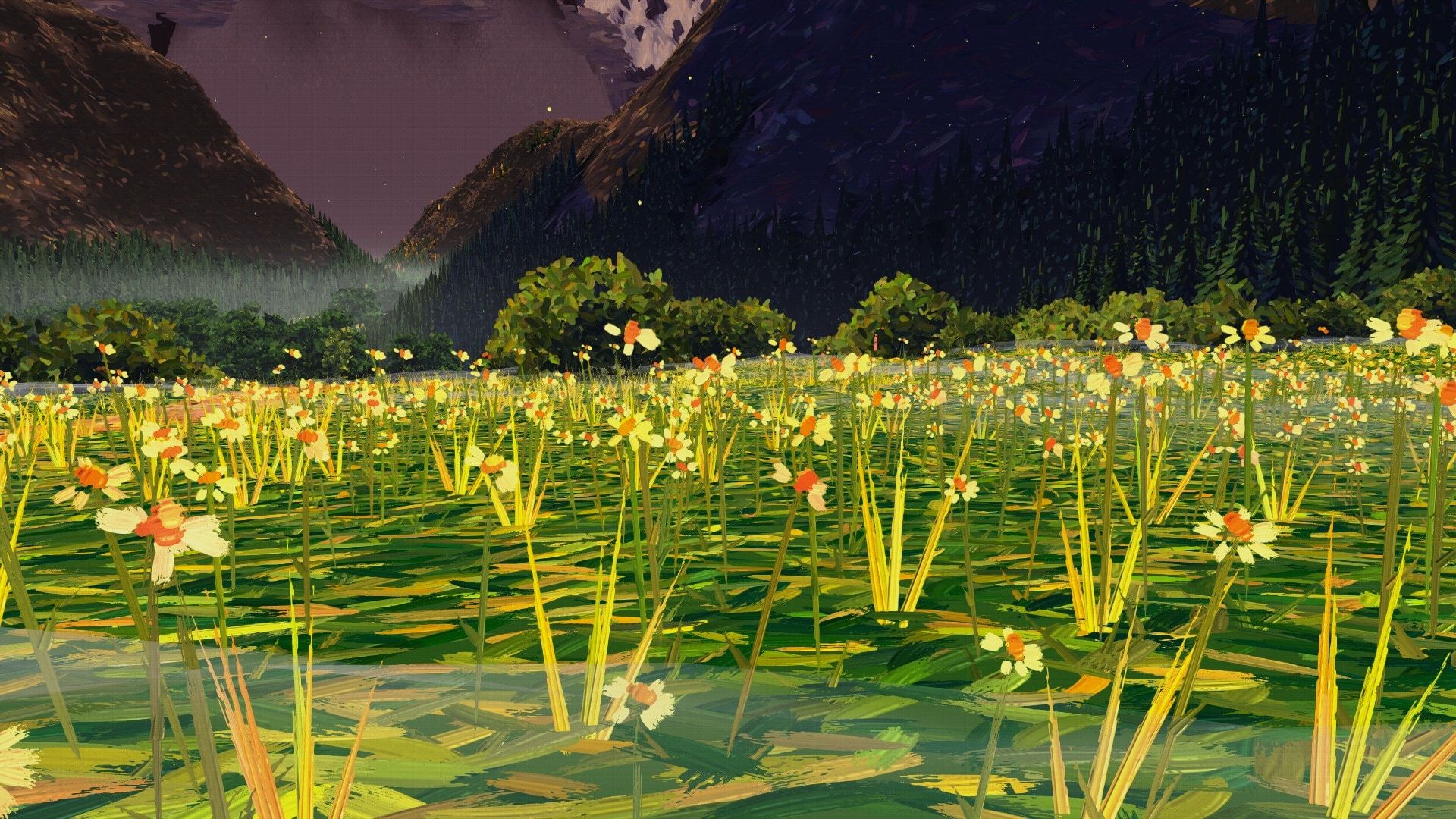
A stroke
A stroke is one small card that shows one mark of a brush. There are sixteen marks, and none of them is drawn by hand: they are made in code from a model of the brush itself, a row of bristle clumps that each touch down at their own moment, carry their own load of paint, leave a ridge, skip where they are dry and give out before the stroke ends.
- Long strokes, straight and curved, for wood, stone and ground.
- Short touches for a flower’s head or a rivet.
- Touches for leaves, pressed down and drawn off to one side.
- Flicks, full at the foot and lifted to a point, for blades of grass, and one that splays for fern.
- Scumbles, a dry brush dragged flat, and a single dab: the least a brush lays.
Every stroke is pinned to its place in the world. Some stand across your line of sight; others lie on the surface they paint. Their edges are cut hard, not blended, so paint sits on paint the way it does on a canvas.
No lights
There is no lamp in the scene and no shadow pass over the picture. Each stroke asks, for the spot it is pinned to, what the sun’s shade is there, what hour it is, how near the torch is and how much mist lies between it and your eye, and it mixes its own colour from the answers. A colour is a pile of paint from a row of the palette, dark to light, chosen by light and by chance when a thing is painted.
The torch is the same. Its light is asked for stroke by stroke: it falls on what is turned to it, it casts shadows, and it reaches little into crevices.
Broad strokes under fine ones
A painter blocks a thing in with a broad brush and finishes it with a fine one. So does the game. A tree, a house or the castle is laid once, in levels: broad strokes underneath, finer ones over them. From far away you see the broad ones; as you come near, the finer ones come in on top.
Nothing is swapped for a more detailed copy as you approach, and nothing appears or vanishes by distance. From afar a thing is the same thing in fewer and larger strokes.
Strokes that never spin
Cards that always face the viewer have a well-known fault: walk under a tree and its leaves turn with you. Here a leaf lies as it lies in the world and turns only as its tree does. The wood of a tree is laid as rigid sticks end to end along each limb, so a bough seen from below is still a bough. A cloud’s strokes are fixed to their cloud and do not turn against it as it drifts overhead.
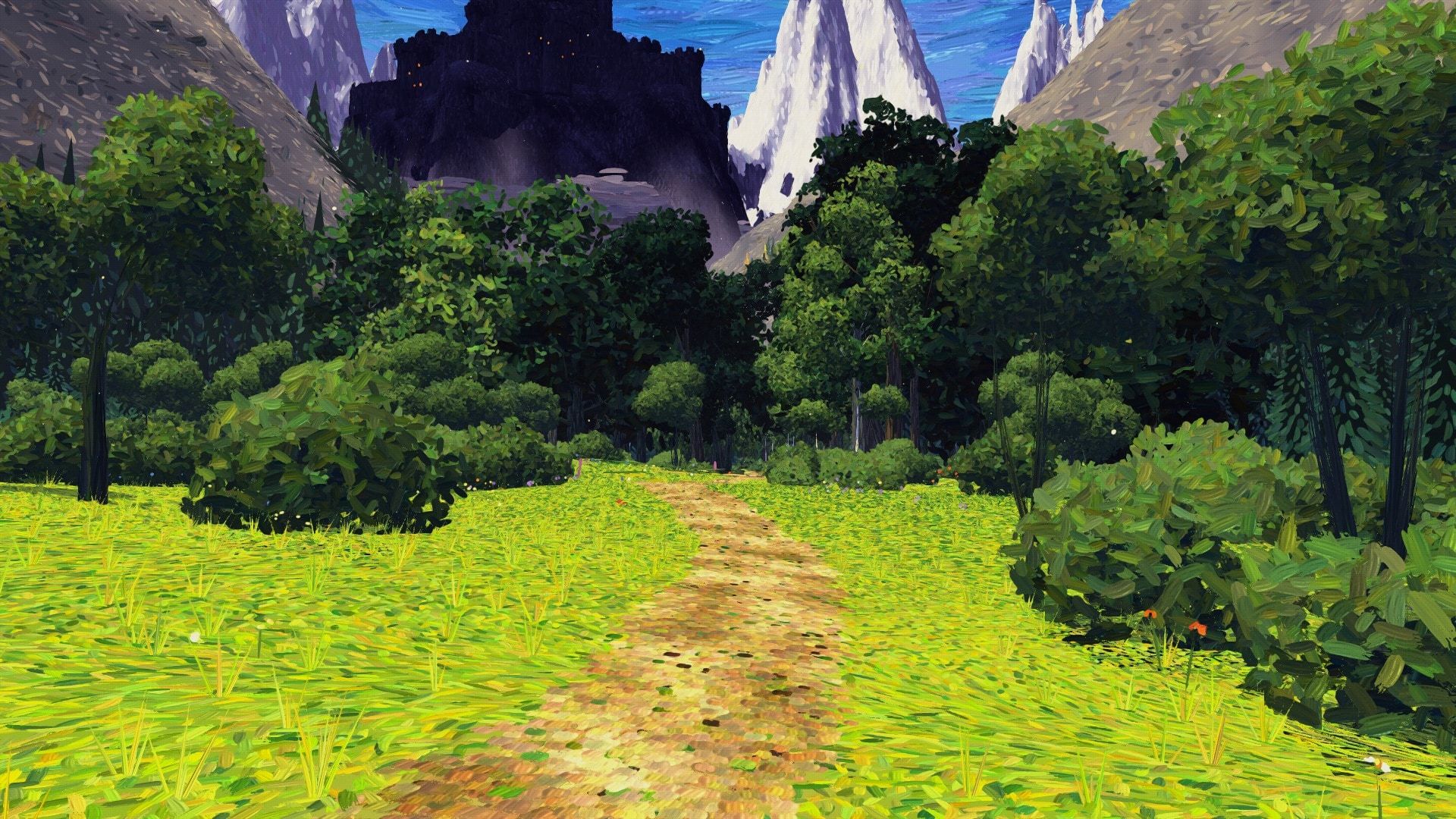
A day timed by the road
The day turns with the distance walked, not with a clock: sunrise at the first step, midday a kilometre on, golden hour as summer goes over into autumn, night in the snow. The sky’s colour is the hour’s, the morning mist lies low in the valley, and the sun goes down behind the walker so that the castle ahead is lit warmly by it.
The numbers
These were measured in the game on a Ryzen 5 5600X with an RTX 4070, in November 2026.
| The valley | 6 km of path, to the gorge at the foot of the castle’s rock |
|---|---|
| Strokes in the whole valley | Some thirty million. Too many to keep, so none are stored: the land is formulas, and it is painted round the walker as he comes |
| Strokes in the scene | 2.8 to 5.3 million at any moment |
| Marks on the brush sheet | Sixteen, each made in code |
| Lights in the scene | None |
| Time to draw the picture | 4 to 7 milliseconds on the graphics card at 1080p; 7 to 9 before the gate, where the cliff fills the view |
| Memory | 1.0 to 1.7 GB |
| Time to paint the start | 12 to 14 seconds |
| Kinds of tree with branches | Nine, each grown as a skeleton of limbs and then painted |
| Kinds of meadow flower | Eight, standing in drifts |
Whose idea it stands on
The idea is not this game’s own. Painting a 3D world in brush dabs pinned to it, over an underpainting, with a brush sheet made in code, is that of oil-paint by blendi, published under the MIT licence. None of its code is in the game. The painter here was written for this valley, in the Godot engine: its brush, its shaders, its palette and its finish are its own. The credits list everything else the game stands on.
More on single parts of the method is in the devlog. If you have come for the game and not the method, walk the valley or read the tale so far.